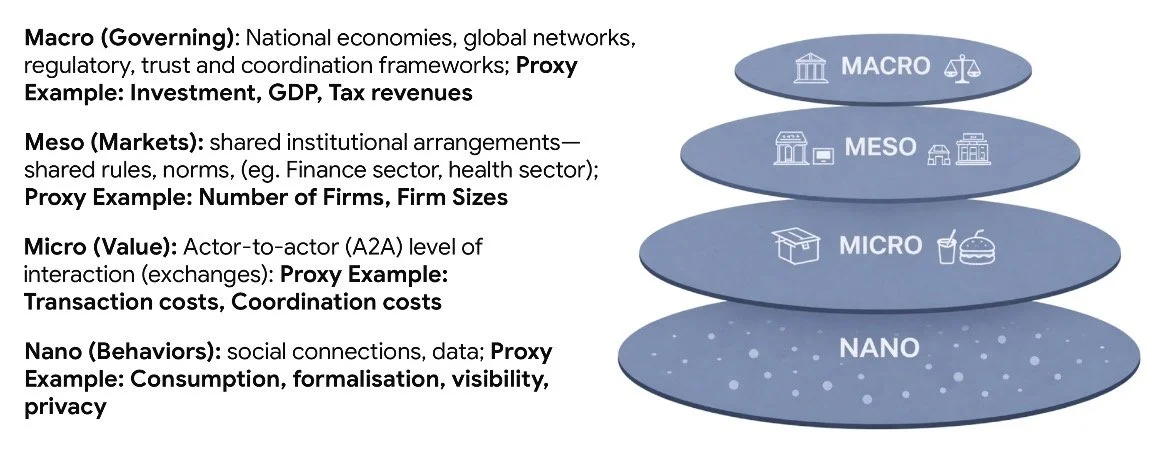
There is a persistent habit in economics and policy to separate the world into neat layers: the state governs, markets organise, firms transact, and individuals behave. It is analytically convenient—but increasingly misleading.
The reality today is far more entangled. What happens at the level of individual behaviour (nano) reshapes value creation (micro), which in turn restructures markets (meso), and ultimately pressures the very foundations of governance (macro). Each layer has its own logic, yet deeply coupled to the others.
Ecosystem design is the only lens that meaningfully cuts across all four layers at once.
1. The Macro Layer: The Limits of the State
At the macro level, states provide governance—laws, regulations, and frameworks for trust and coordination. GDP and tax revenues serve as proxies for success.
But here lies the first fracture.
No state today is truly global, yet economic activity increasingly is. Digital interactions, data flows, and platform-mediated exchanges routinely cross jurisdictions. This creates a structural mismatch: national governance attempting to regulate transnational systems.
As a result:
Regulatory reach is fragmented
Trust is inconsistently enforced
Coordination breaks down across borders
States are not failing—they are simply bounded. And those boundaries matter less and less in a digital world.
2. The Meso Layer: Markets Become Coordination Systems
Traditionally, markets were places of exchange—goods and services traded under shared rules.
Today, markets are evolving into something else: coordination economies.
Across sectors—from finance to healthcare—entire layers of activity are emerging not to produce goods, but to enable interaction:
Identity verification (KYC)
Trust and reputation systems
Data interoperability
Compliance infrastructures
These are not peripheral—they are becoming the core.
Digital markets are no longer just about what is exchanged, but how exchange is made possible. And critically, they operate across sectors, not within them.
This is where platforms have thrived: by internalising coordination. But in doing so, they also centralise control—creating new dependencies and new asymmetries.
3. The Micro Layer: Value Under Pressure
At the micro level, value is realised through transactions—consumption, production, exchange.
But this layer is under increasing strain.
Why?
Because the simplicity of scalable products depends on someone else handling the complexity of coordination. When platforms internalise coordination, they reshape the nature of what is traded:
Products become simpler, more standardised
Services become modular and platform-dependent
Firms shrink or expand depending on their reliance on external coordination
In other words, the boundary of the firm is shifting, not because of production efficiency alone, but because coordination has been outsourced—or captured.
This puts pressure on traditional markets:
Margins are squeezed
Differentiation erodes
Value migrates toward those who control coordination
4. The Nano Layer: Behaviour as the New Frontier
At the base lies the most underestimated layer: behaviour.
Social connections, data generation, visibility, privacy choices—these are not just personal matters. They are economic primitives.
Changes at this level are profound:
Individuals are more connected, but also more exposed
Data is continuously generated, but unevenly controlled
Expectations of privacy and agency are shifting
These behaviours directly affect:
What gets transacted (micro)
How markets are structured (meso)
What governance must respond to (macro)
For example:
Increased concern for privacy challenges data-driven business models
Demand for transparency reshapes trust mechanisms
Informal behaviours becoming formalised alters economic visibility (and taxation)
The nano layer is not “soft”—it is foundational.
5. Why Ecosystem Design Cuts Across All Four Layers
If each layer influences the others, then designing within just one is insufficient.
This is precisely why ecosystem design matters.
An ecosystem is not a market, a platform, or a policy framework. It is a designed system of interactions that deliberately aligns:
Governance (macro)
Institutional arrangements (meso)
Value exchanges (micro)
Behavioural patterns (nano)
And it does so simultaneously.
6. The Case for Ecosystem Thinking Now
Three structural shifts make this unavoidable:
1. No state can be global
Yet economic activity is. Ecosystems provide coordination mechanisms that can operate across jurisdictions without requiring a single sovereign authority.
2. Digital markets are coordination economies
They are not confined to sectors. Identity, trust, verification, and data flow across industries. Ecosystems allow these to be designed as shared infrastructure rather than monopolised functions.
3. Value is destabilised by behaviour
As individuals generate more data, demand more agency, and participate more actively, traditional value models are disrupted. Ecosystems can embed these behaviours into the design of markets rather than treating them as externalities.
7. From Control to Design
The deeper implication is this:
We are moving from a world where systems are controlled within layers to one where they must be designed across layers.
States cannot simply regulate markets—they must engage with ecosystem architectures
Firms cannot just compete on products—they must position within coordination systems
Markets cannot assume stable behaviours—they must adapt to evolving human-data dynamics
Ecosystem design becomes the discipline that holds this together.
8. A Final Thought
The four layers—macro, meso, micro, nano—are not a stack. They are a system of mutual dependencies.
Ignoring any one layer leads to fragility:
Governance without behavioural insight becomes ineffective
Markets without coordination design become extractive
Value without trust collapses
Behaviour without structure leads to chaos
Ecosystem design is not an optional lens—it is the only way to work coherently across all four.
And in a world where coordination is the new economy, that coherence is everything.
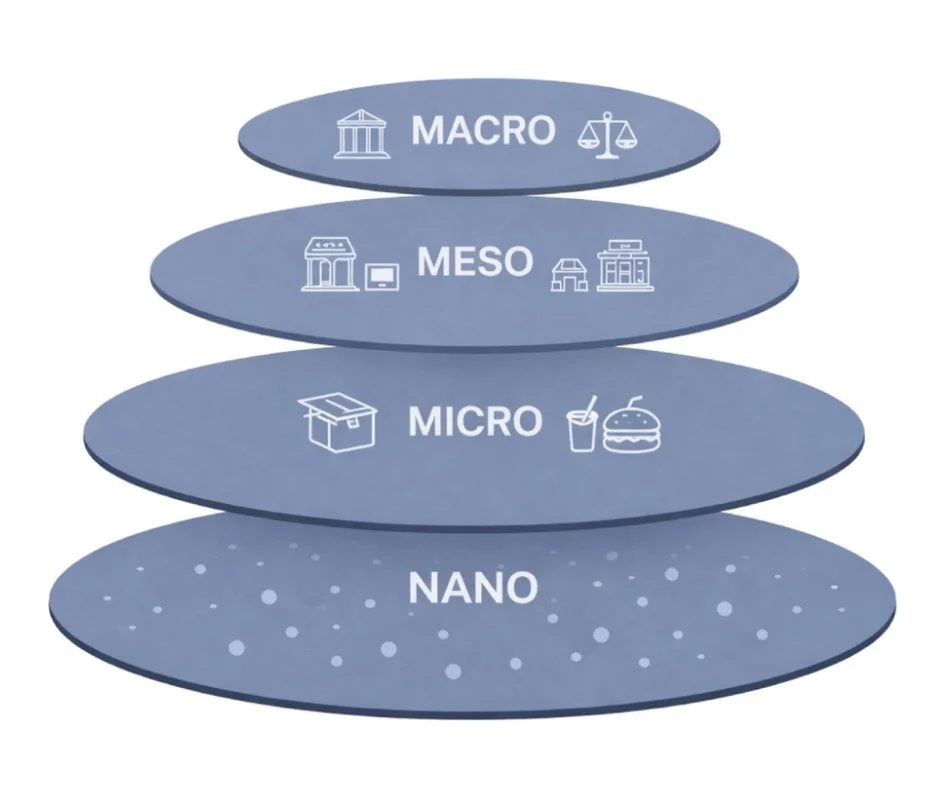
The Four Layers of Economic Society
The 4 layers of economic society describe the interconnected system through which economic activity is governed (macro), organised (meso), realised (micro), and enacted (nano). These are not stacked layers, but analytical lenses on a single, entangled system.